
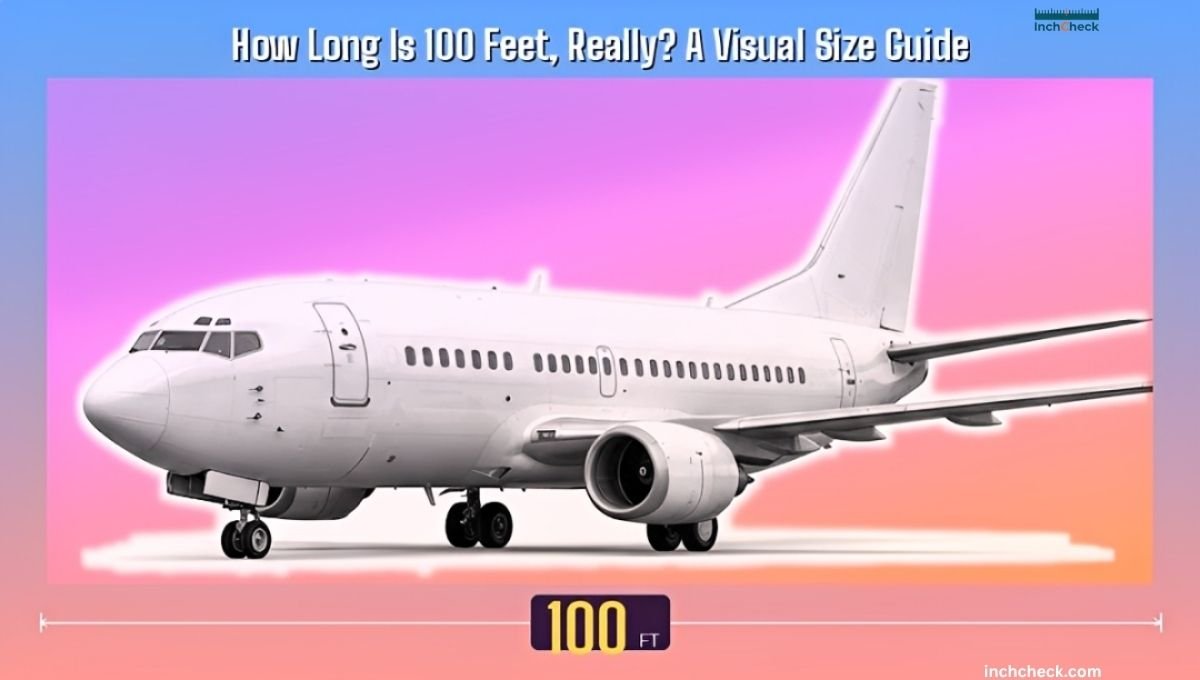
How Long Is 100 Feet, Really? A Visual Size Guide
A blue whale is shorter than you think. So is a 10-story building, almost. Both hover right around the exact length people search for when they ask how long is 100 feet. It’s a distance you’ll recognize the moment you see it.
That number surprises most people once they see it. It equals 1,200 inches, or 30.48 meters , and if you’re also asking how high is 100 ft, how long is 100 ft, how big is 100 ft, or how long is a 100 ft, the answer is the same number, every time.
100 Feet Conversion Table
Before comparing 100 ft to real objects, it helps to see it across every unit at once. This conversion table covers the metric system and imperial units side by side, so you can jump straight to whichever figure you need.
Feet are the default in US construction and real estate, while the metric system is standard almost everywhere else. Millimeters show up mostly in engineering and manufacturing, where fractional inches aren’t precise enough.
| Unit | Value |
| Feet | 100 ft |
| Inches | 1,200 in |
| Centimeters | 3,048 cm |
| Meters | 30.48 m |
| Kilometers | 0.03048 km |
| Yards | 33.33 yd |
| Millimeters | 30,480 mm |
| Miles | 0.01894 mi |
How Long Is 100 Feet in Meters
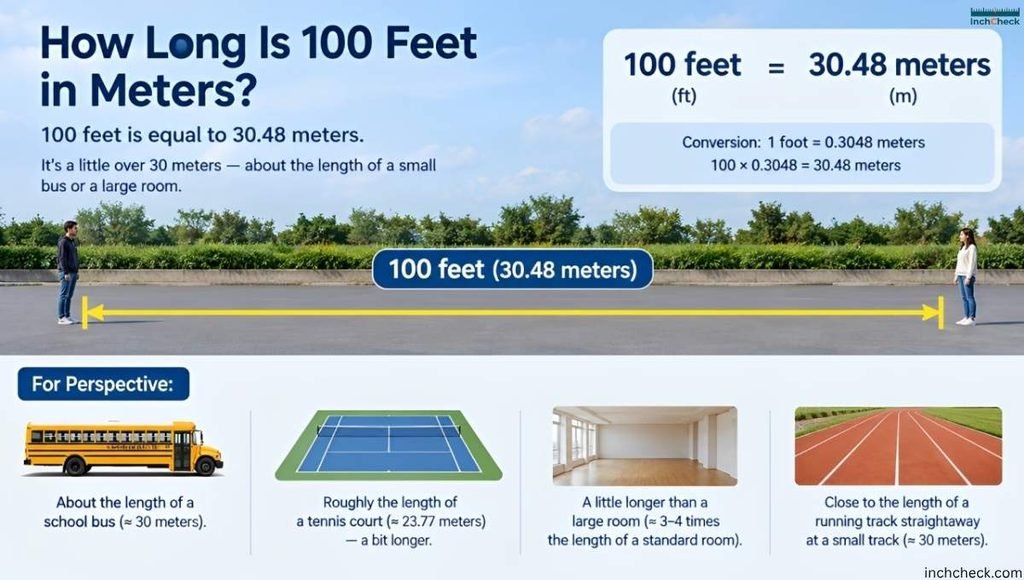
100 feet in meters comes out to 30.48 meters exactly, using the standard feet to meters conversion of 1 ft = 0.3048 m. This figure applies consistently regardless of context, whether you’re reading a blueprint or a product listing. It’s one of the most commonly searched foot-to-meters conversions for this reason.
That’s a figure worth memorizing if you regularly compare US measurements to metric building plans. It saves you from reaching for a calculator every time the unit switches. Once you have it fixed, converting other feet measurements to meters becomes far quicker too.
How Long Is 100 Feet in Miles
100 ft in miles is a small fraction , about 0.01894 miles, or just under two-hundredths of a mile. It’s a useful conversion when you’re estimating short walking distances rather than driving distances.
100 Feet to KM
100 ft to km converts to 0.03048 kilometers. At that scale, it’s easier to think of 100 ft as a fixed real-world object (like a row of buses) than as a fraction of a kilometer.
100 Feet to CM
100 feet to cm equals 3,048 centimeters. This conversion is common in interior design and flooring plans, where centimeters offer more precision than meters alone.
100 Feet to Meter Square
100 ft to meter square isn’t a direct conversion, since feet measure length and meters squared measure area. If you mean a 100-foot by 100-foot square, that’s 10,000 square ft, which converts to roughly 929 square meters.
What Does 100 Feet Look Like?
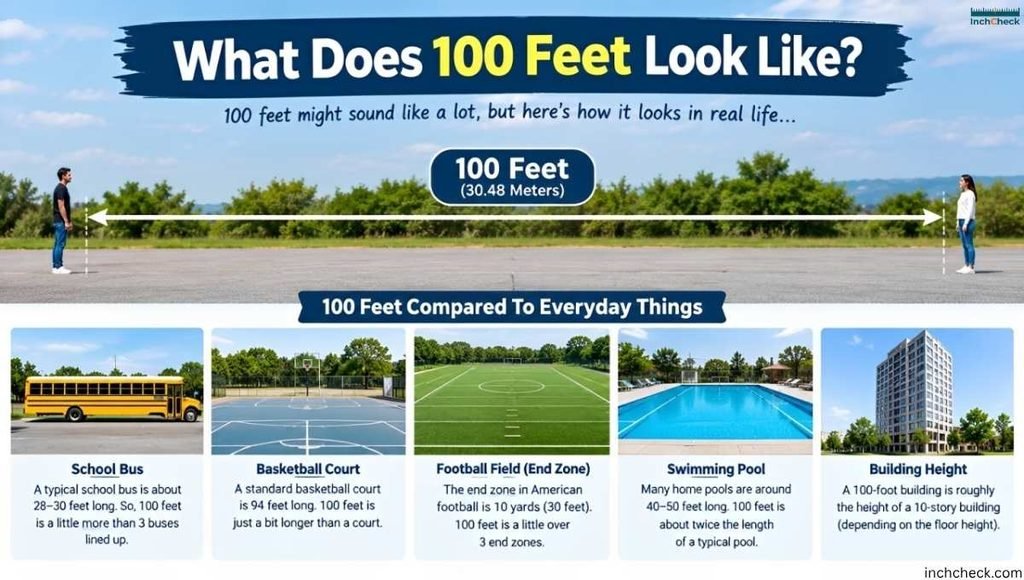
Stand at one end of a suburban street and look toward the third or fourth house down , that gap is close to 100 ft in real life. It’s long enough that a person at the far end looks noticeably smaller, but short enough to walk comfortably in well under a minute.
Indoors, 100 ft distance rarely fits inside a single room. It’s closer to the horizontal length of a warehouse aisle, a school hallway, or the full run of a big-box retail store.
“If 100 feet is clear, our how far is 200 feet guide visualizes that distance with five shipping containers and a Manhattan city block.”
8 Real-World Objects Close to 100 Feet
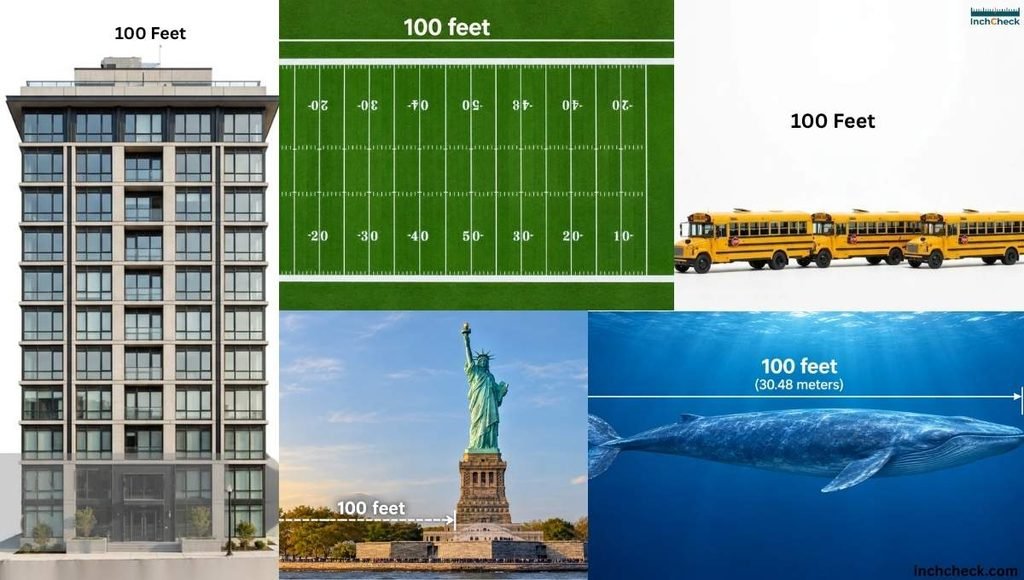
Not every comparison below hits exactly 100 feet , and that matters. Each object here is labeled with its actual verified dimension and source type, so you know which are exact matches and which are close approximations.
Blue Whale (Closest Recorded Length)
The blue whale is the largest animal on record, with confirmed lengths close to 98 feet based on NOAA and marine biology data. It’s often rounded to 100 ft in casual comparisons, though the true record sits just under that mark, and its scale still reads as longer than most city buildings are wide , making it a strong reference for how long is 100 ft.
10-Story Building (Standard Floor Height)
Commercial building design commonly plans each floor at around 10 ft, a figure used broadly in construction planning, so stacking ten floors lands almost exactly on 100 feet. You’ll see this scale in mid-rise offices and apartment buildings in almost any city, and standing at the base makes the height feel immediate and steep , one of the clearest everyday answers to how tall is 100 feet.
Four City Buses Lined Up
A standard 40-foot transit bus, such as those built to New Flyer’s XD40 manufacturer specification, means two and a half buses lined up equals 100 ft, while four shorter 25-foot shuttle buses reach the same distance. City bus length is a comparison almost everyone has seen firsthand, and that continuous row of shuttle buses parked bumper to bumper is one of the most reliable everyday pictures of 100 ft length.
11 Standard Parking Spaces in a Row
Under ADA guidelines and common US parking area regulation, a standard parking space runs 8.5 to 9 feet wide, so roughly 11 spaces in a row reach 100 ft, making parking lots a genuinely practical land measurement reference. You’ll find this exact layout at any shopping center or office parking area, and counting the repeating painted stripes across a row gives a fast, everyday answer to 100 ft distance.
NBA Basketball Court Length
An NBA basketball court measures 94 ft from baseline to baseline under official league regulation, just short of 100 ft and one of the most widely recognized fixed-length spaces in the country. Extending it by roughly six more ft , about one extra step past each baseline , gets you to the full 100 ft, a close way to judge 100 ft comparison without needing a whale or a building.
One-Third of an NFL Football Field
An NFL football field measures 300 ft between end lines under official NFL regulation, meaning 100 ft is almost exactly one-third of that playing length, or closer to a quarter once both end zones are included. Picturing the yard markers , 100 ft lines up with roughly the 33-yard stretch , makes it a dependable, widely understood way to picture this distance.
Statue of Liberty Pedestal
The Statue of Liberty pedestal stands 89 feet tall, according to National Park Service data , close but not an exact match for 100 ft, since the statue itself rises well beyond that. Millions of visitors see it each year at Liberty Island, where the pedestal alone already dominates the skyline before the statue begins , a near-match, not an exact one, for how tall is 100 ft.
Young Coast Redwood Tree
Coast redwoods are among the fastest-growing conifers, and conservation data indicates they can reach roughly 100 ft within several decades of growth, well before their full mature height. You’d find trees at this height in coastal redwood forests, short of the towering old-growth giants further into the grove , a natural, if less precisely dated, answer to how tall is 100 ft.
Size Comparison Table: 100 Feet vs Everyday Objects
| Object | Actual Length/Height | Source Type |
| Blue whale | ~98 ft | Marine biology / NOAA data |
| 10-story building | ~100 ft | Construction design standard |
| 4 shuttle buses (25 ft each) | 100 ft | Manufacturer specification |
| 11 parking spaces | ~99 ft | ADA guidelines |
| NBA basketball court | 94 ft | NBA official regulation |
| NFL field (end line to end line) | 300 ft | NFL regulation |
| Statue of Liberty pedestal | 89 ft | National Park Service |
| Young coast redwood | ~100 ft | Conservation growth data |
How Long Is 100 Feet in a Room
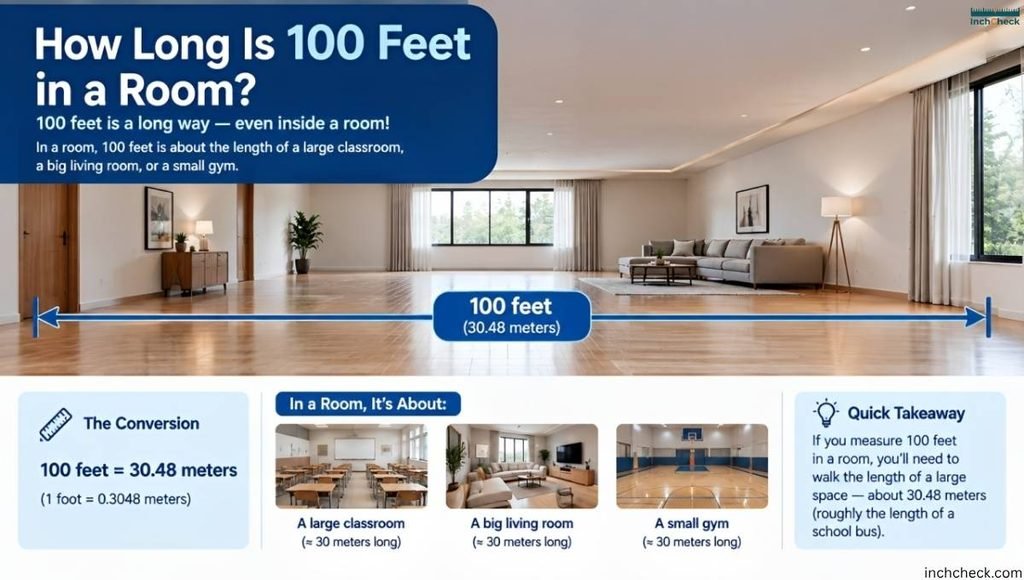
Most residential rooms fall well short of 100 ft in any direction, so this distance rarely fits inside a single space. It’s closer to the combined length of two or three connected rooms, or the full run of a long hallway.
In commercial spaces, 100 ft distance is closer to the aisle length in a mid-size warehouse or the depth of a big-box retail floor. If you’re picturing this for a home renovation, think in terms of your whole house’s footprint rather than one room.
How Tall Is 100 Feet Compared to a Human
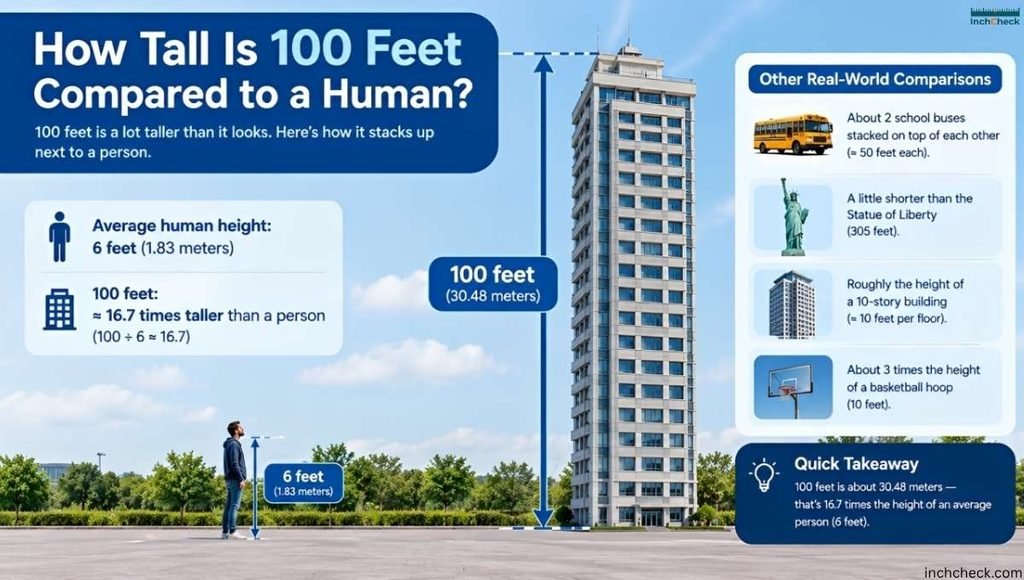
Using an average adult height of 5 feet 9 inches, roughly 17 to 18 people would need to stand on each other’s shoulders to reach 100 feet. That stacked visual makes the scale far more concrete than the raw number alone.
| Reference | Height | Comparison to 100 Feet |
| Average adult | 5 ft 9 in | About 1/17th of 100 feet |
| 10 adults stacked | 57.5 ft | Just over half of 100 feet |
| 17-18 adults stacked | ~100 ft | Matches 100 feet height |
How Tall Is 100 Feet Building
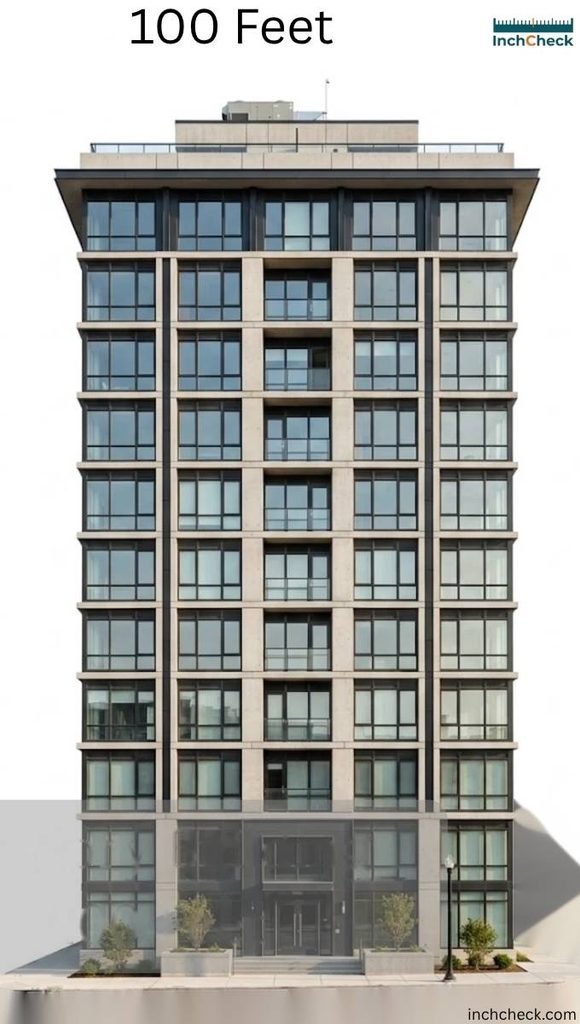
A building reaching 100 feet typically runs about 10 stories, based on the common construction planning standard of roughly 10 ft per floor. That estimate can shift slightly depending on ceiling height and structural design, but it still holds as a reliable rule of thumb. Most mid-rise buildings across US cities follow this same rough scale.
Compared to a typical two-story house at 20 to 25 ft, a 100-foot building is roughly four to five times taller. It’s a height you’ll recognize instantly from almost any downtown skyline. No exact building needs to come to mind for the scale to feel familiar.
100 Feet vs Other Distances
| Comparison | Difference | Real-World Equivalent |
| 100 ft vs 80 ft | +20 ft | About one extra shuttle bus |
| 100 ft vs 120 ft | +20 ft short | Roughly one delivery truck’s length |
| 100 ft vs 200 ft | Half the distance | Twice the length of 100 feet, or two basketball courts end to end |
How to Measure 100 Feet Without a Tape Measure
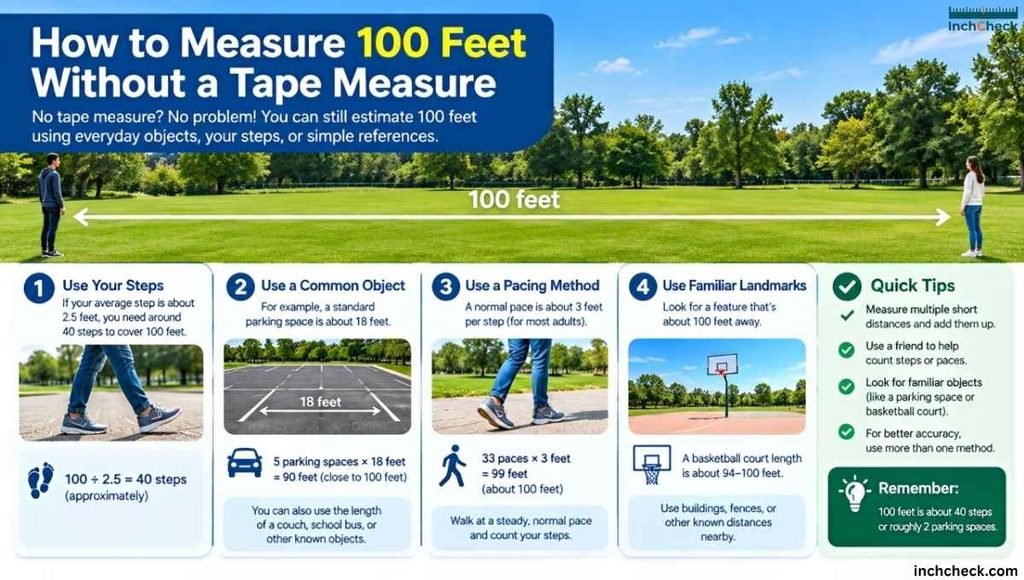
You don’t need a tool to get a reasonably close estimate of 100 ft , these three methods use your own body and the objects already covered above.
Counting Steps (Stride Method)
Most adults walk with an average stride of about 2.5 feet per step, so counting roughly 40 steps gets you close to 100 feet. For better accuracy, measure your stride once over 10 steps with a tape before relying on it elsewhere. Keep your pace natural and stick to flat, open ground like a driveway or sidewalk.
Floor Tiles Method
Many patios, garages, and warehouse floors use 1-foot square tiles, making the floor tiles method one of the simplest ways to count out 100 feet indoors. Walk in a straight line and count each tile until you reach 100. Double-check your start and end points, and make sure the tile sizing is consistent before relying on the count.
Arm Span Method
Your arm span is roughly equal to your height, so a 6-foot-tall person needs about 17 arm spans to cover 100 feet. Stretch fully and mark each endpoint before moving to the next span. It’s slower than counting steps but useful indoors, and repeating it carefully beats rushing through it.
Common Misconceptions About 100 Feet
A few mix-ups come up often enough to be worth clearing up directly. Confusing meters with feet is the most frequent error , 100 ft is 30.48 meters, not 100 meters, which is a much larger distance (roughly 328 ft). Feet and yards get mixed up too, since 100 ft is 33.33 yards, not 100 yards, a distance three times longer.
Not every “close to 100 ft” object listed above hits the mark exactly. Bus lengths, floor heights, and tree growth all vary by model, design standard, or growth stage. Treat these as reliable approximations rather than fixed, universal constants.
Also Read About: So, How Big Is 30 cm Compared to Everyday Objects?
Also Read About: How Long Is 3 Feet, Explained Simply
Frequently Asked Questions
Is 100 Feet a Long Distance?
Yes, 100 ft equals 30.48 meters, making it a long distance, about two and a half city buses lined up end to end.
How Long Is 100 Feet Compared to a Football Field?
100 feet is about one-third of an NFL football field’s 300-foot playing length, or roughly a quarter of the field including both end zones.
How Long Is 100 Feet on a Road?
On a road, 100 ft is about seven car lengths, or roughly two and a half city buses parked bumper to bumper.
What Does 100 Feet Look Like?
100 feet looks like the height of a 10-story building, or the length of four 25-foot shuttle buses lined up in a row.
How Far Is 100 Feet to Walk?
Walking 100 ft takes about 20 to 25 seconds at a normal pace, roughly equal to 40 average adult steps in a straight line.
What Objects Are 100 Feet Long?
Objects close to 100 ft include a 10-story building, four 25-foot shuttle buses in a row, and roughly 11 standard parking spaces lined up.
How Many Cars Is 100 Feet?
100 ft fits about six to seven average passenger cars parked end to end, based on a typical 14 to 17-foot car length.
Conclusion
So, how long is 100 feet? It equals 1,200 inches, 30.48 meters, and 3,048 centimeters. The clearest way to picture it: a 10-story building, four 25-foot shuttle buses lined up, or one-third of an NFL field’s 300-foot playing length. It’s also a distance you can walk in about 20 seconds, yet tall enough to dominate a city block.
Wondering how high is 100 feet? That same 10-story building answers it , roughly 17 to 18 average adults stacked shoulder to shoulder. Whether you’re asking how long is 100 ft, how big is 100 ft, or how long is a 100 ft, the answer stays exactly the same.