

How Tall Is 40 Feet, Really? Feet, Meters & Real-World Height Comparisons
Stand at the base of a four-story building. Look straight up. That’s how tall is 40 feet ,and how high is 40 feet exactly is 480 inches, or 12.19 meters. No rounding, no guesswork involved. So what does 40 feet look like in real terms?
For 40 feet visualized, think shipping containers and utility poles. Both are reliable, standardized things that are 40 feet long you’ve likely passed today without noticing. One lies flat, the other stands tall ,same exact measurement either way.
How Tall Is 40 Feet?
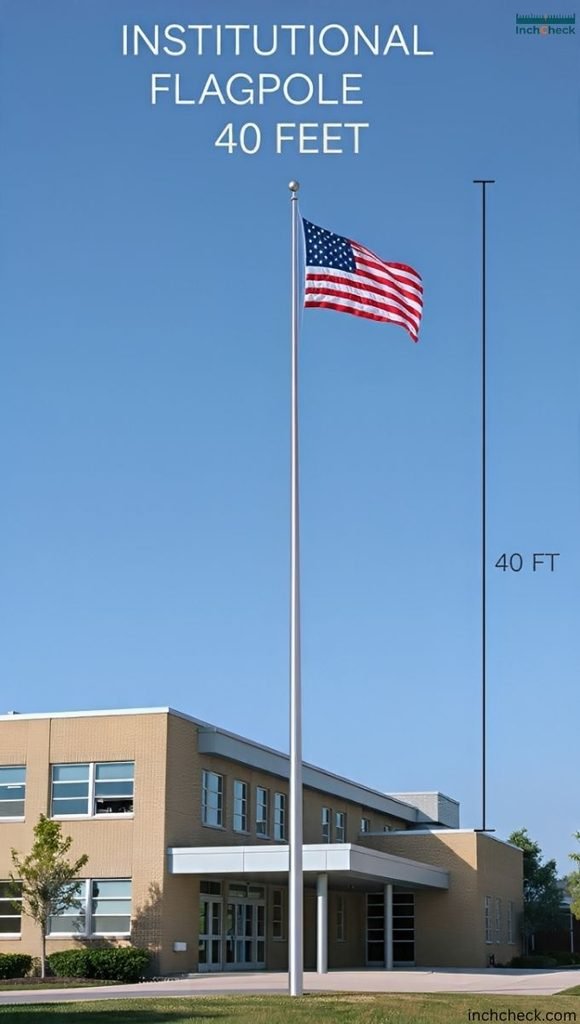
Forty feet is a length that appears everywhere once you start looking for it ,from shipping containers to city buses to specific spans in building codes. In more precise terms, it equals 480 inches, 12.19 meters, 1,219.2 centimeters, and 13.33 yards. Knowing these conversions helps when specs are written in one unit but you’re used to thinking in another.
Because raw numbers can be hard to picture, comparisons help bring the scale to life. Forty feet is roughly the height of a four-story building, and it’s also a bit taller than a standard telephone pole. Both of these mental images make it easier to grasp just how substantial that measurement really is.
40 Feet Conversion Table
Here’s the full 40 feet conversion table across every unit you’re likely to need, from millimeters up to yards.
Bookmark this section if you’ve landed here specifically for “40 feet to meters” or “40 feet to inches” ,the numbers below are exact, not rounded estimates.
| Unit | Exact Equivalent |
| Feet | 40 ft |
| Inches | 480 in |
| Yards | 13.33 yd |
| Millimeters | 12,192 mm |
| Centimeters | 1,219.2 cm |
| Meters | 12.19 m |
Quick formulas:
- Feet to inches: multiply by 12 (40 × 12 = 480 in)
- Feet to meters standard conversion: multiply by 0.3048 (40 × 0.3048 = 12.19 m)
- Feet to yards: divide by 3 (40 ÷ 3 = 13.33 yd)
What Does 40 Feet Look Like?
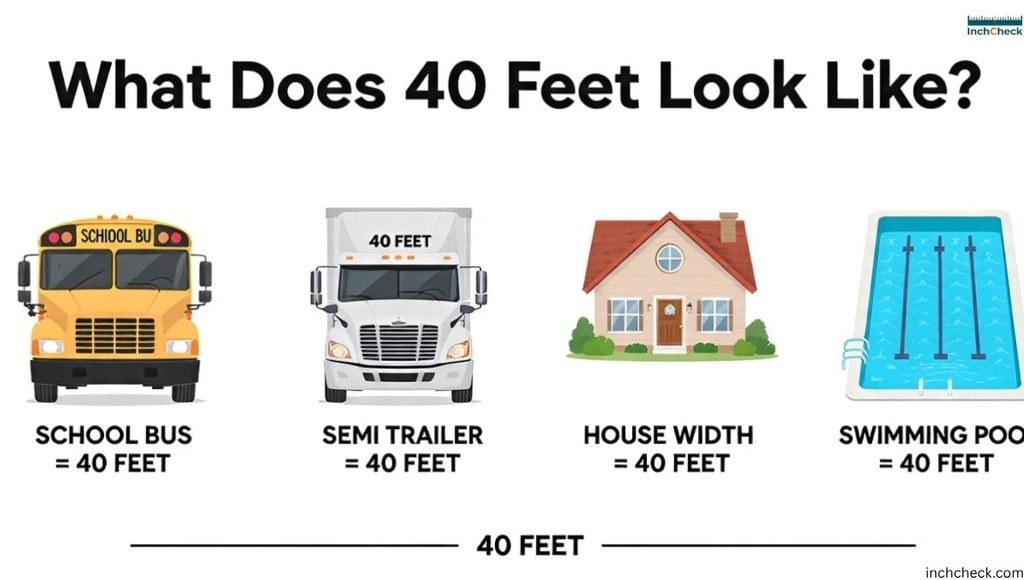
Picture standing at the base of a four-story building and craning your neck to see the top ,that’s roughly what 40 feet looks like vertically, using the common estimate of about 10 feet per story. It’s a height that commands attention, the kind you notice from a distance. Seen this way, the number stops being abstract and starts feeling like a real physical presence.
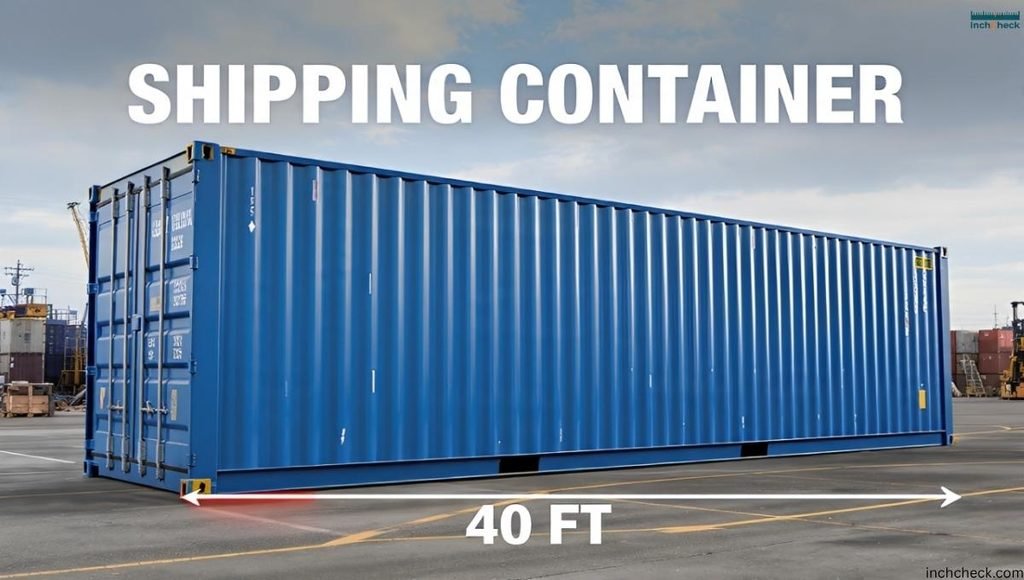
Now picture that same 40 feet laid flat on the ground ,it’s the length of a standard ISO shipping container, end to end. That’s a distance you could walk in just a few seconds without much thought. The contrast is the interesting part: identical measurement, but height reads as imposing while length reads as ordinary and easy to cover.
40 Feet Size Comparison Table
The objects below are limited to ones with a real, checkable spec ,a manufacturing standard or industry classification ,rather than a rough visual guess.
| Object | Dimension | Orientation | Source/Standard |
| ISO shipping container | 40 ft (12.19 m) long | Length | ISO 668 international container standard |
| Container semi-trailer chassis | 40 ft long | Length | Built to ISO 668 container specification |
| ANSI utility distribution pole | 40 ft total height | Height | ANSI O5.1 wood pole standard |
| Commercial flagpole | 40 ft tall | Height | NAAMM FP 1001-07 flagpole guide specification |
| Heavy-duty transit bus | 40 ft long | Length | FTA/APTA transit bus size classification |
| Four-story building (rule of thumb) | ~40 ft tall | Height | Common ~10 ft-per-story architectural estimate |
Things That Are Exactly 40 Feet
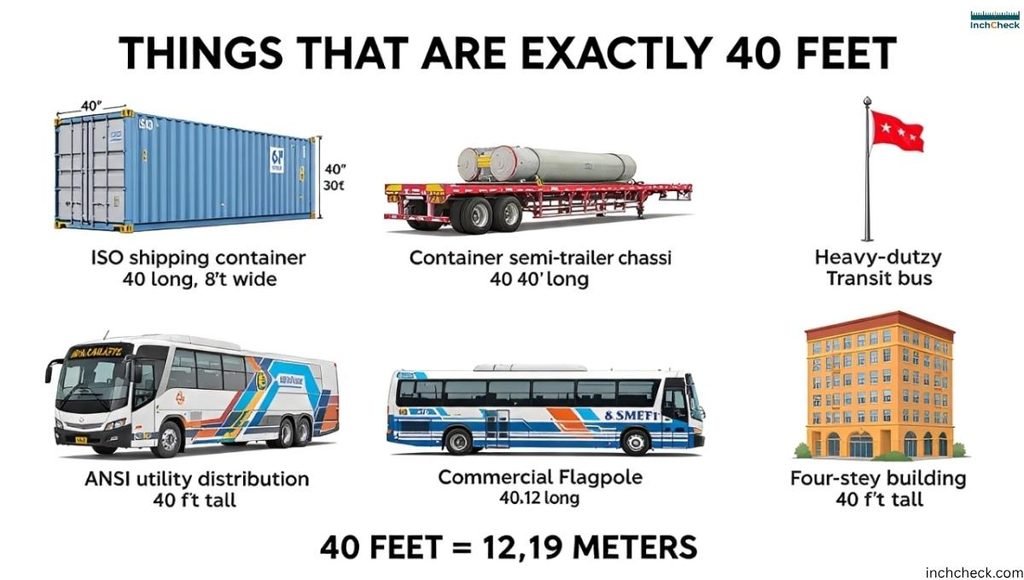
Each entry below is a real, standardized item ,not a hedge like “some buses” or “many poles.”
1. ISO shipping container
This is the full-size ocean freight container used worldwide for cargo shipping. It’s built to the ISO 668 standard at exactly 40 feet (12.19 m) long, 8 feet wide. You’ll see these stacked at ports, on rail cars, and pulled behind trucks. The 40-foot container is one of the most reliable real-world objects 40 feet long anywhere in the world.
2. Container semi-trailer chassis
This is the wheeled trailer frame built specifically to carry a 40-foot ISO container over the road. Its length matches the container exactly, since it’s engineered around that same ISO 668 spec. On the highway, it looks like a long flatbed frame with the shipping container locked on top. This semi-trailer container unit is a dependable horizontal reference for 40 ft measurement.
3. ANSI-rated utility distribution pole
This is the wood pole carrying local power and telecom lines through residential neighborhoods. A standard 40-foot pole, built to ANSI O5.1, sits about 34 feet above ground with roughly 6 feet buried below grade. It’s a tall, tapered wooden post you pass on nearly every street. This gives a solid reference for 40-foot pole height in a vertical context.
4. Commercial flagpole
Schools, office parks, and municipal buildings commonly install flagpoles at 40 feet, a standard height defined by NAAMM FP 1001-07 guide specifications, typically paired with an 8×12-foot flag. It’s a tall, tapered aluminum shaft rising straight into the air. This institutional flagpole size is one of the clearest vertical answers to how tall is 40 feet.
5. Heavy-duty transit bus
Many city transit systems classify their full-size buses at 40 feet, a standard length category used by U.S. transit agencies and manufacturers. It’s a long, boxy vehicle that takes up a full traffic lane. The full-length city bus remains one of the most familiar real-world objects 40 feet long that people see daily.
6. Four-story building (architectural estimate)
Using the common ~10-feet-per-story rule of thumb used in building design, a four-story structure lands close to 40 feet tall. It’s a useful mental model, though actual story heights vary by building type and code. This is the fastest way to answer how tall is 40 feet compared to a building.
40 Feet Compared to Other Sizes
Seeing 40 feet next to nearby lengths makes the 40 feet size comparison easier to hold onto ,a school bus, a few parked cars end to end, or half a bowling lane all sit in that same rough range.
| Length | Difference From 40 Feet |
| 35 feet | 5 feet shorter |
| 40 feet | — |
| 45 feet | 5 feet longer |
| 80 feet | 40 feet longer (exactly double) |
40 feet vs 35 feet is roughly the height difference of half a story, while 40 feet vs 45 feet is a smaller, five-foot gap. 40 feet vs 80 feet shows the doubling trick clearly ,two 40-foot shipping containers end to end equal 80 feet exactly.
How Tall Is 40 Feet in Stories?
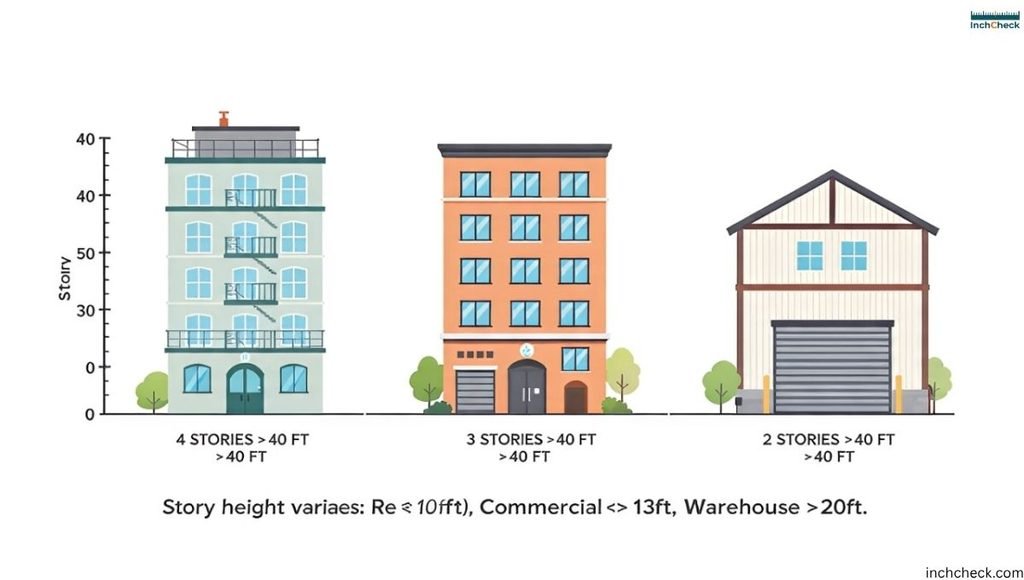
Using the common architectural estimate of about 10 feet per story, 40 feet works out to roughly four stories. This is a planning rule of thumb, not a fixed building code. Actual story heights vary by ceiling height and floor structure.
Commercial and older residential buildings sometimes run closer to 9–12 feet per story. That range can shift a “40-foot building” anywhere from three to four-and-a-half stories. Building type plays a real role in the final count. Always treat this as an estimate, not an exact structural figure.
40 Feet vs. a Human’s Height
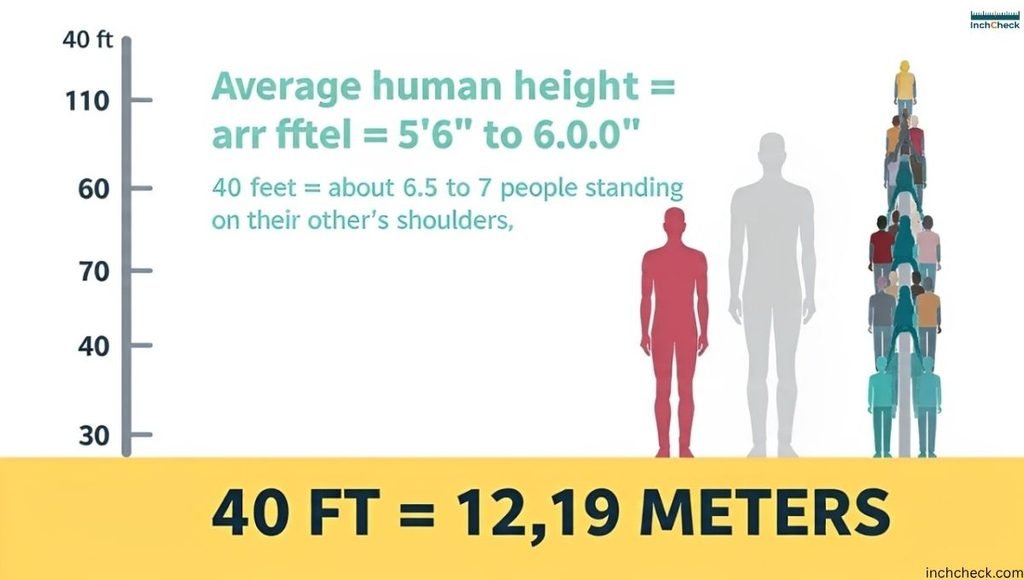
There’s no single verified object standing in for “average human height,” so this comparison works best as a multiplier. At roughly 5 to 6 feet for a typical adult, 40 feet is about 6 to 8 times a person’s height stacked vertically.
That scale is why a 40-foot flagpole or utility pole feels genuinely tall standing next to it ,it towers roughly seven times higher than the person looking up at it. It’s the kind of height that turns heads and makes people instinctively step back to take in the whole thing.
Common Misconceptions About 40 Feet
Two mix-ups come up constantly with this measurement, and both can throw off a construction estimate or online purchase. Getting the unit and the math right avoids costly errors.
Each misconception below gets its own explicit rule so there’s no ambiguity left. This keeps the corrections easy to scan and apply, without any room for guessing which rule fits which case.
Confusing 40 Feet With 40 Meters
40 feet (12.19 m) is nowhere close to 40 meters (about 131.2 feet) ,the two differ by more than a factor of 10. This mix-up usually happens on international spec sheets or product listings that switch units without warning. Always confirm the unit before ordering materials or estimating a structure’s height.
Mixing Up Feet and Yards
Because 13.33 yards doesn’t round evenly, it’s tempting to estimate rather than calculate ,but the feet-to-yards conversion only works by dividing by 3 every time. For example, 40 feet is 13.33 yards, not “13 yards” rounded down, which would actually be 39 feet. Double-check the math before ordering yardage-based materials like fencing or fabric.
Estimating 40 Feet Without Tools
If you don’t have a tape measure, a few practical methods get you a close estimate using everyday movement and objects already covered above. These rely on things you already have access to, like your own stride length or familiar objects nearby.
Each method below is a genuine measuring-without-a-tape-measure trick, not a rough guess. Used carefully, they can get you within a foot or two of the actual distance every time.
Method 1: Count your steps
A normal adult step covers roughly 2.5 feet, so about 16 steps in a straight line gets you close to 40 feet. This is one of the fastest estimating 40 feet without tools methods available anywhere.
Method 2 : Use floor tiles
If your tiles are 1 foot square, count 40 tiles in a row for an exact match. This works well indoors on any consistently sized tile floor.
Method 3 : Reference a known object
A single 40-foot shipping container or a utility pole from the table above gives you an instant, standardized visual reference ,no counting required.
Also Read About:How Heavy Is 100 Grams in Real Life? (100 Grams Weight Guide)
Frequently Asked Questions
How tall is a 40 feet building?
A building described as how tall is 40 feet tall is roughly four stories, using the common 10-feet-per-story estimate ,taller than most houses, shorter than a typical office tower.
How many stories is a 40 foot tall building?
Using the standard ~10-feet-per-story rule, a 40-foot building is about four stories tall, though this varies with ceiling height and construction type.
What is 40 feet comparable to?
How tall is 40 feet? It’s comparable to a 40-foot ISO shipping container, a commercial flagpole, or a utility distribution pole ,all built to that exact height or length.
What does 40 feet tall look like?
Visually, how tall is 40 feet looks like a four-story building or a tall flagpole rising overhead ,roughly 6 to 8 times the height of an average adult.
How to visualize 40 feet?
Picture a 40-foot shipping container lying flat, or a utility pole standing upright ,both real, standardized objects that make how tall is 40 feet easy to picture.
How many meters is 40 feet tall?
40 feet tall converts to exactly 12.19 meters, using the standard conversion of 0.3048 meters per foot ,the same figure used in construction worldwide.
How big is 40 ft long?
40 ft long equals 480 inches or 12.19 meters ,the exact length of a standard ISO shipping container used in global freight shipping.
Conclusion
So, how tall is 40 feet? Exactly 480 inches, or 12.19 meters ,a clean, exact conversion every time. That’s also the answer to how high is 40 feet: roughly four stories, or a commercial flagpole standing overhead.
What does 40 feet look like? For 40 feet visualized, picture a 40-foot ISO shipping container lying flat, or an ANSI-rated utility pole standing upright ,two of the most reliable things that are 40 feet long anywhere. Skip the guesswork: 40 feet converts cleanly, and these verified objects make the scale instantly clear, whether you’re picturing it lying down or towering straight up.