
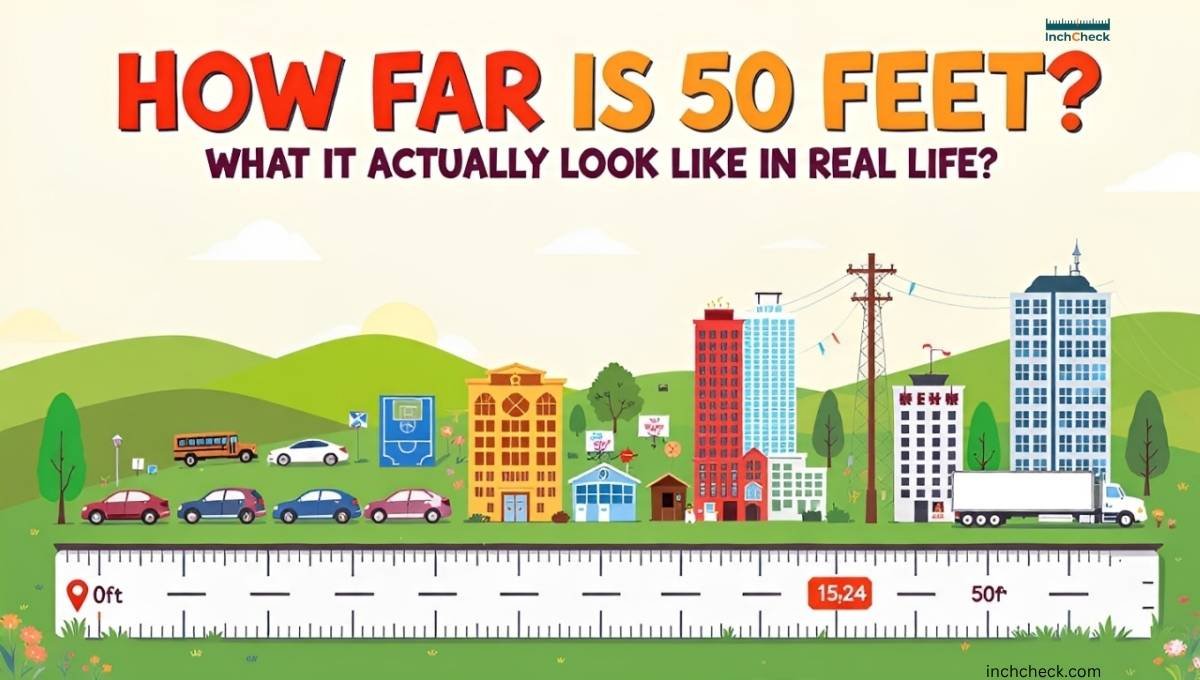
How Far Is 50 Feet? What Does It Actually Look Like in Real Life?
How far is 50 feet? Most people can’t say. Almost no one can picture it without help. That’s the gap this guide closes. 50 feet equals 600 inches, 15.24 meters, or 16.67 yards ,one fixed distance, several ways to express it.
Once 50 feet visualized against something real, the number finally sticks. You’ll see exactly how long 50 ft measures out, how tall is 50 ft compares to a five-story building, and get a full 50 ft comparison against objects you already recognize ,no tape measure required.
50 Feet Conversion Table
For quick reference, 50 feet in meters rounds to 15.24 m, and 50 feet in yards comes out to roughly 16 yards and 2 feet. This feet to meters conversion is fixed and doesn’t change based on context ,it’s the same whether you’re measuring a yard, a room, or a parking lot.
| Unit | Value |
| Millimeters | 15,240 mm |
| Centimeters | 1,524 cm |
| Meters | 15.24 m |
| Inches | 600 in |
| Yards | 16.67 yd |
| Feet + Inches | 50 ft 0 in |
Here’s the exact length of 50 feet across every major unit, useful whether you’re working in metric or imperial measurements.
What Does 50 Feet Look Like?
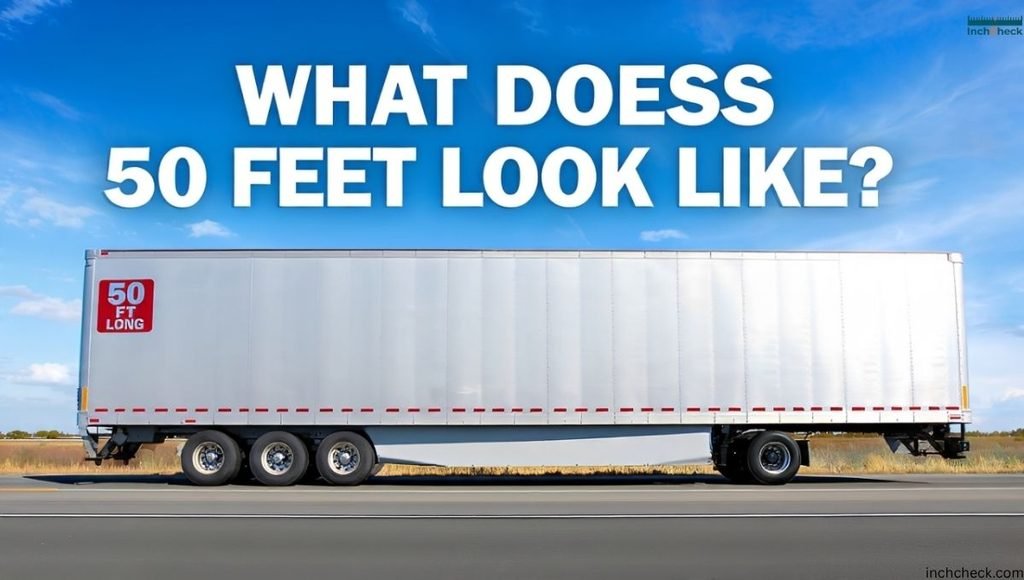
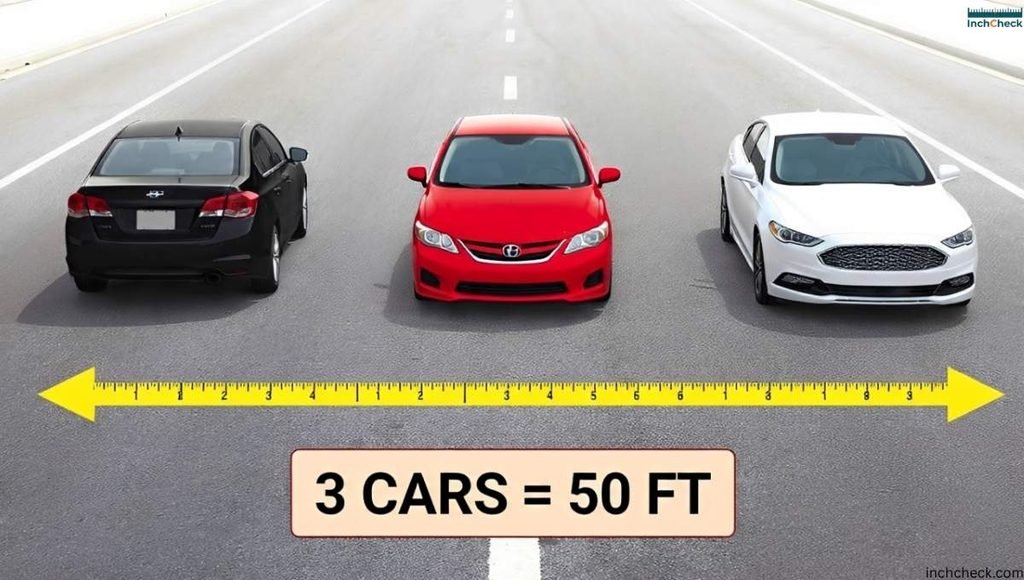
Picture three parked cars lined up bumper to bumper, or the width of a standard bowling lane doubled. That’s roughly the visual footprint of 50 feet ,long enough to separate two houses, but short enough to walk across in under ten seconds.
Context changes how the distance reads. Indoors, 50 feet can span an entire house from front to back. Outdoors, in a parking lot or field, the same distance feels ordinary and easy to judge. This indoor vs outdoor distance shift is one reason people underestimate 50 feet size until they see it against something familiar.
“For a smaller scale, our how far is 20 feet visually guide shows that distance using two car lengths and a large room width.”
9 Things That Are Exactly 50 Feet Long
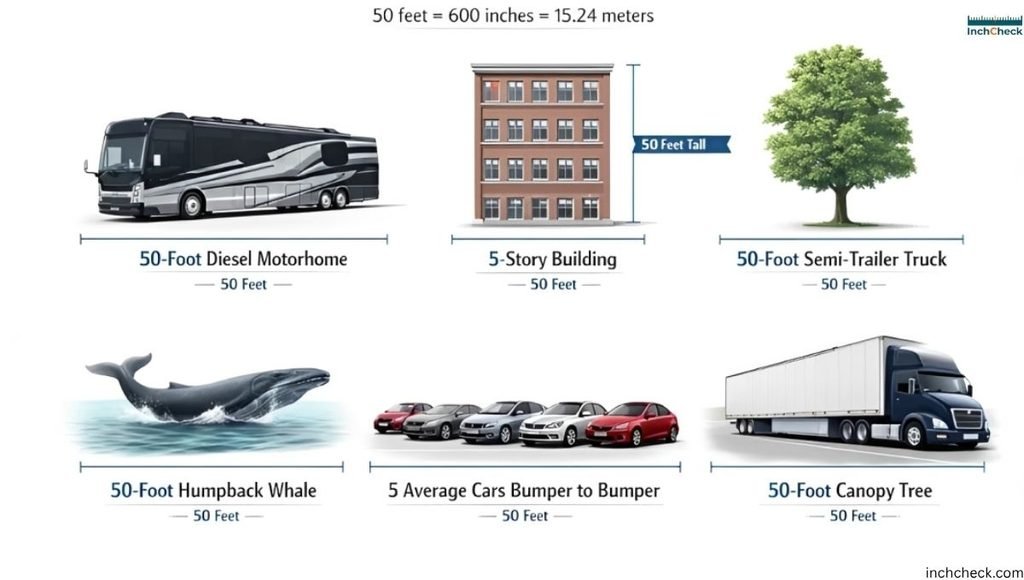
Each object below includes its verified dimension and source type, so you’re comparing against confirmed specs rather than rough guesses.
Semi-Truck Trailer
Standard freight trailers used in U.S. logistics run 48 to 53 feet, based on Department of Transportation freight trailer standard length regulations. A 50-foot trailer sits within this common range, though it isn’t a fixed universal spec. You’ll see these daily on highways, and standing beside one shows just how much space 50 feet actually occupies. It’s one of the most common real-world references for how long 50 feet is.
NBA Basketball Court Width
An NBA court measures exactly 50 feet wide, per official NBA court dimensions published in the league rulebook. This is one of the few objects on this list with an exact, regulation-locked match. Standing on one sideline and looking to the other gives you a precise, repeatable sense of the distance. It’s the clearest way to visualize 50 feet size without needing a tape measure.
50-Foot Class Sailing Yacht
Boat manufacturers classify certain cruising and racing sailboats under a 50-foot sailing yacht length category, based on manufacturer hull-length listings. These boats are common in marinas and offshore racing fleets. Viewed dockside, the hull stretches noticeably longer than a standard vehicle or small boat. This comparison works well for anyone picturing 50 ft across open water.
Five-Story Building Height
A typical building story runs about 10 feet floor to floor, based on standard residential building height codes, which puts a five-story structure at roughly 50 ft tall. You’ll see this scale in apartment blocks and mid-rise offices. Looking up at one shows how differently the same distance reads vertically. This is a reliable answer for how tall is 50 ft in an urban setting.
Utility Pole Span Across a Street
Certain utility pole spacing in infrastructure design span standards allows gaps close to 50 ft between poles on wider streets, though this varies by local utility codes. It’s an approximate match rather than an exact one. You’ll notice this span most on larger roads and intersections. It’s a useful everyday reference, even with the built-in variability.
Mature Urban Shade Tree
Common urban shade trees like oak and maple can reach 50 ft in height at full maturity, based on published arborist growth data. These trees line streets, parks, and older residential blocks. Standing beneath a mature specimen creates a strong upward visual cue. It’s a natural, no-cost way to gauge urban tree height comparable to 50 ft.
Industrial Warehouse Bay Width
Warehouse bay width in many logistics facilities is built to a 50-foot structural spacing standard, based on published warehouse design specifications. This spacing allows equipment and pallets to move freely between support columns. Standing inside one of these bays makes the openness of 50 ft obvious. It’s a practical, functional example of the measurement at work.
Multi-Lane Highway Width With Shoulders
A multi-lane highway width including paved shoulders can approach 50 ft across, based on state department of transportation roadway design manuals. Drivers cross this distance constantly without registering it. Viewed from an overpass, the full width becomes easier to judge. It’s a good everyday answer for how far is 50 ft in a transportation context.
Precast Bridge Segment
Bridge construction frequently uses 50-foot precast structural unit segments, based on standard precast concrete manufacturer specifications, to speed up installation. These segments are visible at active infrastructure and roadway projects. Up close, a single segment reads as a long, rigid slab of concrete. It’s a strong engineering-scale reference for the exact length of 50 ft.
50 Feet Compared to a Football Field
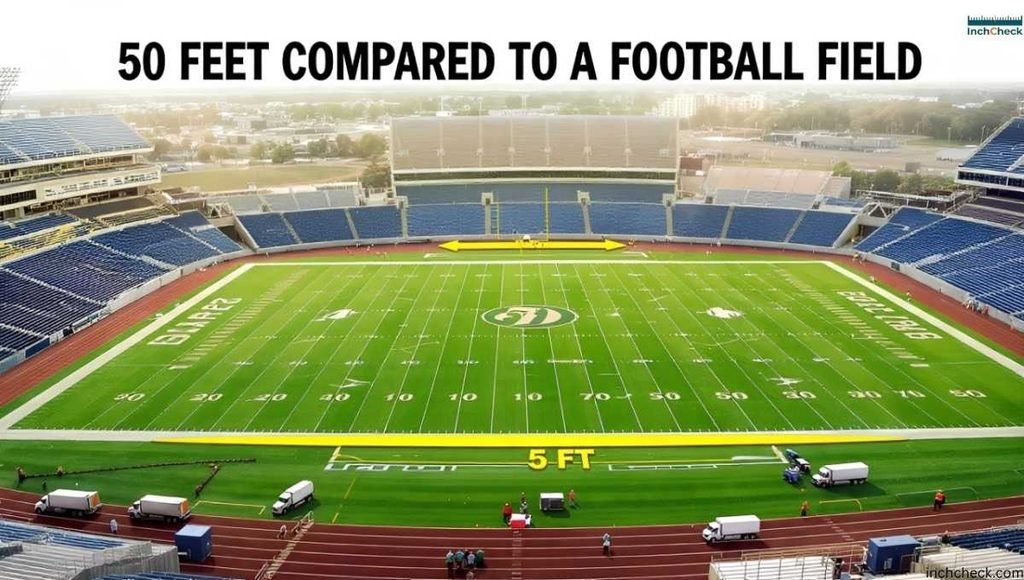
A football field, including end zones, runs 360 feet in total length. So 50 feet works out to a little under one-sixth of that full distance. That’s roughly half of one end zone plus a few extra yards.
If you’ve stood on a football field, that partial-end-zone stretch is a fast mental anchor. It’s an easy way to picture how long 50 ft is compared to a football field. On the field’s 10-yard line markers, it covers roughly five of those marked segments.
How Long Is 50 Feet in a Room?
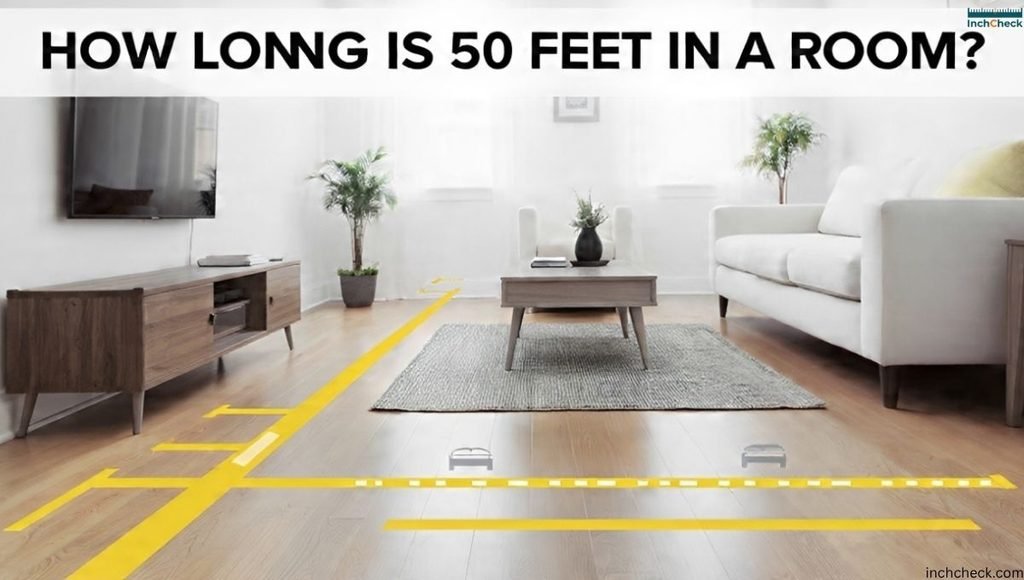
Most residential rooms don’t reach 50 ft in a single direction on their own. This distance usually spans multiple connected rooms or a long hallway plus an adjoining space. Few homes have any single room built to stretch that far uninterrupted.
In an open-concept home, though, 50 ft might stretch from the front entry through the living area and into the kitchen. That kind of layout is where the full distance becomes noticeable indoors. It’s one reason 50 ft indoors can feel more dramatic than the same distance outside.
How Tall Is 50 Feet Compared to a Human?
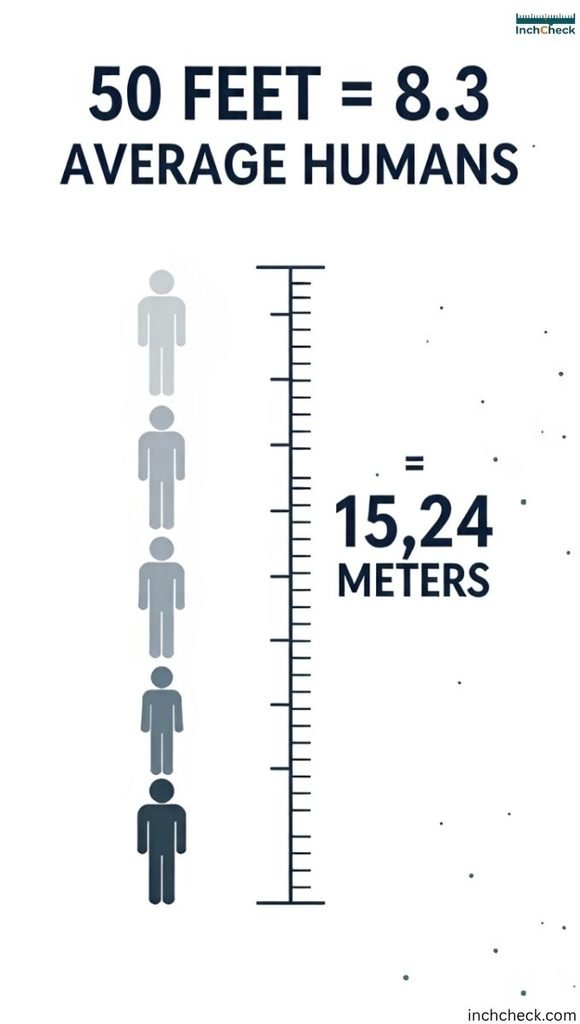
The average adult stands 5 to 6 feet tall, a familiar reference point for most people. That means 50 feet works out to roughly eight to nine people stacked on each other’s shoulders. It’s a scale that’s easy to picture without needing any extra math.
That comparison highlights how tall is 50 feet compared to a human at a glance. It’s a scale most people can picture instantly, since it stays under ten body-lengths. Stacked vertically, that image alone makes the full height feel immediate and real.
How Tall Is 50 Feet Compared to a Building?
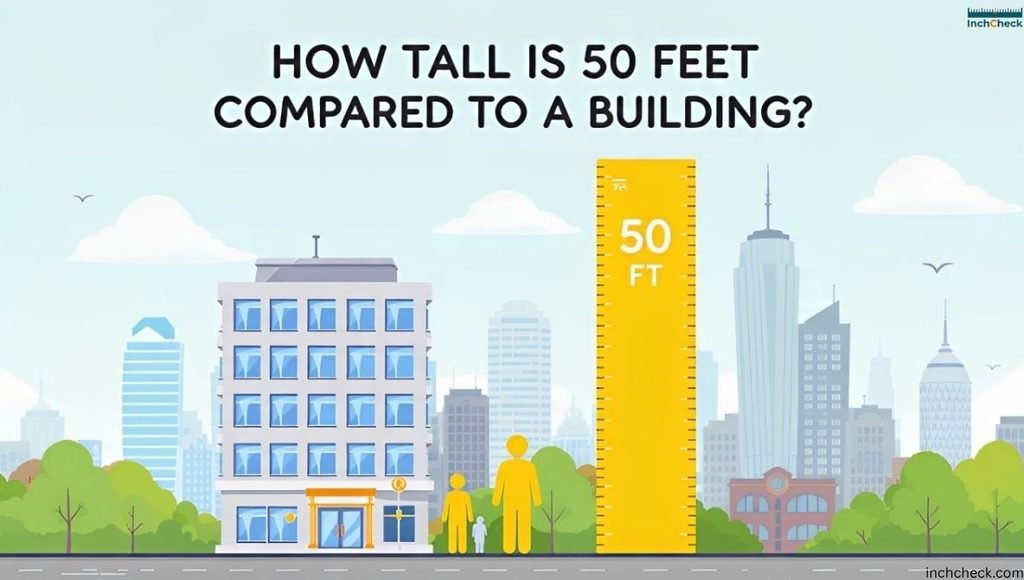
As covered above, a 50-foot tall building typically lines up with a five-story structure. This estimate relies on the common 10-foot-per-story figure found in standard construction codes. It’s a rough but reliable way to size up height from ground level.
That makes 50 feet a useful mental benchmark for everyday situations. Any time you’re sizing up a mid-rise building from the street, this comparison helps. It turns an abstract number into something you can judge at a glance.
50 Feet LED Lights
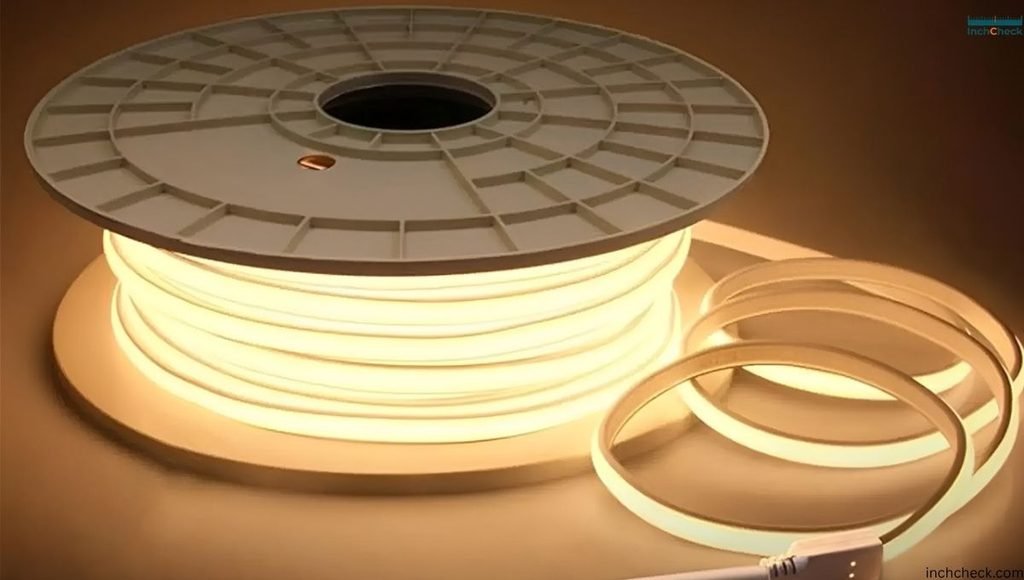
Fifty-foot LED light strands are a common length sold for patios, decks, and outdoor string lighting setups. They’re popular because a single strand can wrap a decent-sized outdoor space without needing extra connectors. This makes them a go-to choice for anyone setting up ambient lighting outside.
When shopping for how long 50 ft LED lights, know that most strands space bulbs every 12 to 18 inches. That spacing is usually enough to cover the perimeter of a mid-size patio or backyard in a single run. Checking the manufacturer’s listed strand length before buying always helps avoid unexpected gaps in coverage.
50 Feet in Meters
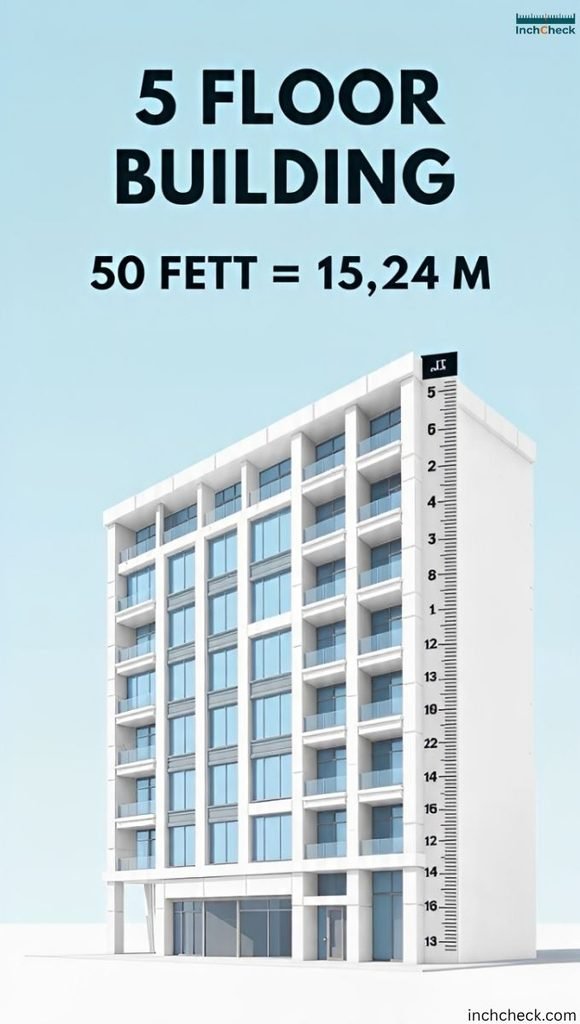
For a fast 50 ft meters conversion, the figure comes out to exactly 15.24 meters. This is a fixed, precise figure with absolutely no rounding ambiguity involved. It holds true no matter what context you’re converting the measurement for.
The reason it stays this exact is simple: one foot always equals 0.3048 meters. That conversion rate never changes, regardless of the distance being measured. Knowing this single figure lets you convert any foot measurement into meters with full confidence.
Size Comparison Table: 50 Feet vs Other Distances
| Comparison | What It Tells You |
| 50 ft vs 40 ft | 10 extra feet, about the length of a compact car |
| 50 ft vs 60 ft | 10 fewer feet, close to a small truck’s front end |
| 50 ft vs 100 ft | Exactly half ,two NBA court widths side by side |
| 50 ft vs school bus | Longer; most school buses run 35–45 feet |
| 50 ft vs football field | About one-sixth of a full 360-foot field |
These distance comparison points are useful any time you need a fast reference without pulling out a tape measure.
How Big Is 50 Feet?
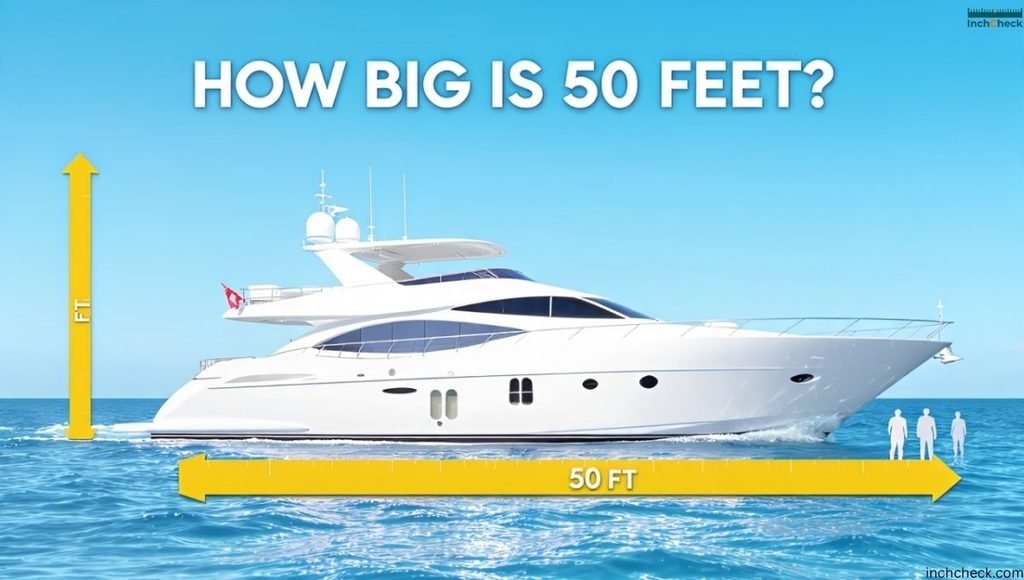
At 15.24 meters, 50 ft sits somewhere between a short driveway and a small parking lot in overall scale. It’s long enough to comfortably separate two houses, yet short enough to shout across without much effort. That range is what makes the distance feel practical rather than abstract.
Wide enough to match an NBA court from sideline to sideline, it also lines up with one of the clearest references available. That single comparison ,the basketball court ,tends to stick best in people’s minds. It works because it’s a fixed, regulation-based measurement rather than a rough estimate.
How to Measure 50 Feet Without a Ruler or Tool
You don’t need a tape measure to get a reasonably accurate estimate. These methods work almost anywhere.
Counting Steps Method
Walk at a normal pace and count your steps ,most adults cover close to 20 steps to walk the distance of 50 feet, since the average step length estimate is about 2.5 feet. This works well outdoors on flat, open ground.
Floor Tile Method
If you’re indoors, count floor tiles instead. Standard tiles are often 1 foot square, so lining up 50 tiles in a row gives a fairly precise result using the floor tile method.
Arm Span Method
For a rough check, use your own body: if you’re around 6 feet tall, your arm span is close to the same length, so roughly 8 to 9 arm spans laid end to end will approximate 50 feet using the arm span measurement approach.
Phone GPS or Map App Method
For outdoor spaces, most mapping apps include a measuring tool that lets you drop two pins and read the distance directly ,a fast way of measuring 50 feet without tools when you’re near a street or open lot.
Common Mistakes: Feet vs. Meters vs. Yards
The most common mix-up is treating feet and meters as roughly equal, but they’re actually quite different. A meter runs about 3.28 feet, so confusing the two can throw off an estimate. That gap can shift a measurement by nearly a third, which adds up fast.
Yards add another layer of confusion on top of that. Fifty feet works out to only 16.67 yards, not an even 50 as some might assume. Keeping these three units straight avoids costly estimation errors in everyday measuring.
Also Read About:How Tall Is 40 Feet, Really? Feet, Meters & Real-World Height Comparisons
Frequently Asked Questions
How long is 50 feet visually?
In real terms, how far is 50 feet looks like three parked cars end to end, or an NBA basketball court’s width.
What is an example of 50 feet?
A clear example is an NBA basketball court, which measures exactly 50 feet wide by official league rule ,a fixed, verifiable real-world reference.
How far is 50 feet to walk?
Answering how far is 50 feet to walk: at a normal pace it takes about 9-10 seconds, roughly 20 steps for most adults.
How big is 50 feet compared to a human?
The average adult stands 5-6 feet tall, so 50 feet compared to a human equals about eight to nine people stacked shoulder to shoulder.
How many steps equal 50 feet?
Most adults take about 20 steps to cover 50 feet, since the average step length is close to 2.5 feet per stride.
How far is 50 feet in yards?
How far is 50 feet in yards? It equals 16.67 yards, since one yard equals 3 feet, a simple, fixed conversion with no rounding.
How big is a 50 foot?
A 50-foot object spans 15.24 meters or 600 inches ,the same length as an NBA basketball court’s width, a fixed and easy visual reference.
Conclusion
How far is 50 feet? It’s 600 inches, 15.24 meters, or 16.67 yards ,an exact, fixed distance once you know the conversion. The fastest way to keep 50 feet visualized is through fixed, verifiable references: an NBA basketball court’s 50-foot width, a five-story building, or three parked cars end to end.
Those three alone answer how long is 50 ft and how tall is 50 ft without guesswork. For a quick 50 ft comparison, it’s roughly nine people stacked shoulder to shoulder, or a little under a sixth of a football field. Anchor the number to one of these objects, and 50 feet stops being abstract ,it becomes something you can spot and judge on sight, anywhere.